

Every business decision starts with a question: What will customers buy? Where should we invest? Which strategy will work best? Today, businesses answer many of these questions by analysing customer behaviour, market trends and financial performance.
Netflix studies viewing patterns to recommend what you might watch next. Amazon analyses browsing and buying behaviour to understand what customers are likely to purchase. Banks analyse financial information to assess risk, while marketing teams study their audiences before planning campaigns.
Behind these decisions are professionals who understand how businesses operate and know how to interpret data.
For students interested in both areas, a BBA in Business Analytics & AI combines business management, analytics and artificial intelligence. It teaches you how businesses operate, how data guides decisions and how AI is changing the way companies plan and solve problems.
Why Are Business Leaders Learning to Work With Data and AI?
Business decisions once relied heavily on experience and intuition. Both still matter, but today, they are increasingly supported by data and AI.
Retailers use business forecasting to estimate demand before stocking products. Banks analyse data to assess financial risk. Marketing teams study customer behaviour to understand who to target and when. Companies forecast sales, while HR teams analyse workforce trends to plan hiring.
This shift matters for students too. You do not need to become a data scientist to lead a business, but you do need to understand what data is telling you and how to use it to make better decisions.
That is why Business Analytics and AI are becoming important skills for the next generation of managers and business leaders.
What Is BBA in Business Analytics & AI?
A regular BBA course teaches you how businesses operate through subjects such as marketing, finance, human resources, operations, and strategy.
A BBA in Business Analytics & AI builds on this foundation by adding another layer: how to use data and artificial intelligence to solve business problems and support decisions.
Students learn areas such as data analysis, statistical methods, predictive modelling, Data Visualisation, business forecasting, AI-driven insights, data governance, and ethical AI practices.
The idea is not to turn every business student into a programmer. It is to prepare graduates who understand business well enough to identify a problem and analytics well enough to find useful answers.
How Is AI Changing Business Leadership?
AI is changing how quickly businesses can understand information and act on it.
Business leaders can use AI to understand customer behaviour, forecast demand, identify potential risks, personalise marketing, and automate repetitive analysis. AI can also help teams compare scenarios before making major decisions.
But AI in Business does not remove the need for human judgement. It changes what good business judgement looks like.
Future business leaders need to know which questions to ask, how to interpret AI-generated insights, and when to question an AI output. The advantage comes from combining technology with context, strategy, and human decision-making.
What Skills Will You Learn in BBA Business Analytics & AI?
A good Business Analytics course develops both management and analytical capabilities.
- Business Fundamentals: Understand marketing, finance, operations, and strategy.
- Data Analysis: Read business data and identify patterns that can influence decisions.
- Data Visualisation: Turn complex information into dashboards, charts, and reports that people can understand.
- Business Forecasting: Use past and current data to estimate future sales, demand, or market trends.
- AI and Predictive Analytics: Understand how AI models can support business planning and decision-making.
- Strategic Thinking: Turn an insight from data into a practical business action.
- Communication: Present data-backed recommendations clearly to teams and decision-makers.
- Ethical AI and Data Governance: Understand how customer and business data should be used responsibly.
These fall into the valuable industry-ready skills because businesses need professionals who can move between numbers, technology, and strategy.

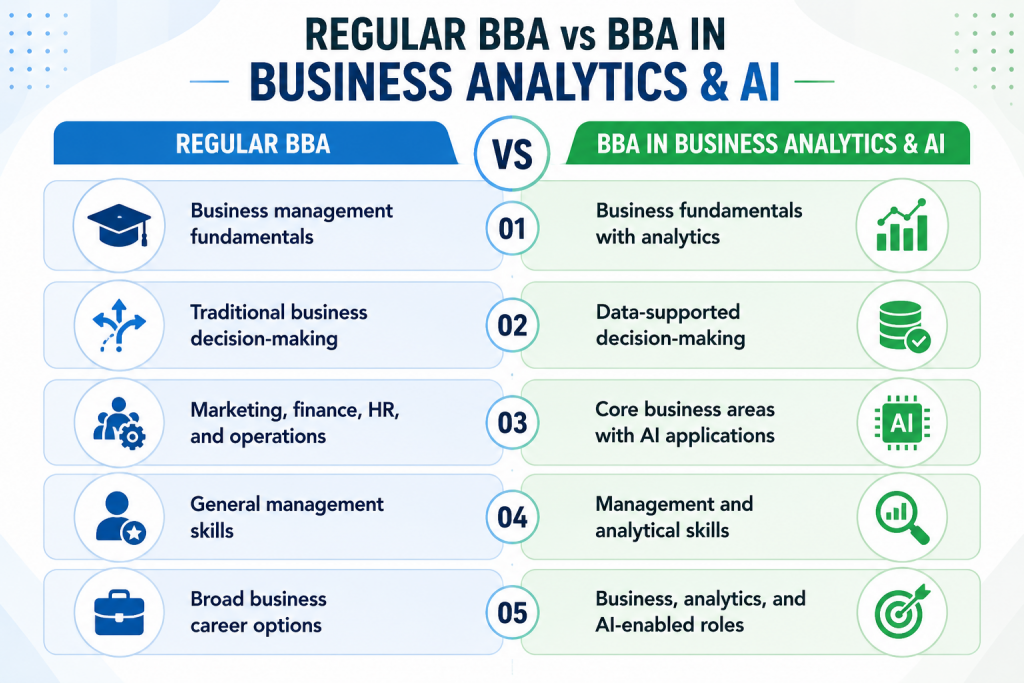
The specialised BBA degree does not replace traditional management education. It builds analytics and AI capabilities on top of it, preparing students for a business environment where data shapes decision-making.
What Jobs Can You Get After BBA in Business Analytics & AI?
The combination of business and analytics can lead to roles across different functions and industries.
- Business Analyst: Studies business problems and recommends improvements.
- Data Analyst: Analyses data to identify trends and useful insights.
- AI Business Analyst: Connects AI capabilities with business requirements.
- Business Intelligence Analyst: Builds dashboards and reports that support decision-making.
- Market Research Analyst: Studies markets, competitors, and customer behaviour.
- Operations Analyst: Uses data to improve business processes and efficiency.
- Financial Analyst: Analyses financial performance and market trends.
- Risk & Analytics Analyst: Uses data to identify and assess potential business risks.
These Business Analytics jobs are found across banking, consulting, FinTech, e-commerce, retail, technology, healthcare, and manufacturing.
So, what does this mean for the future of business analyst careers? AI is now part of the role. Those who understand both the business problem and the AI tools available to solve it can connect management and technical teams.
Why Study BBA in Business Analytics & AI at Shoolini University?
Shoolini’s four-year BBA in Business Analytics & AI combines business fundamentals with data analysis, predictive modelling and AI. Students work on case studies and industry projects to understand how companies use data to make decisions.
Learning from Business Experts: The curriculum includes inputs from professionals at McKinsey, PwC and Citi, along with experts from IITs, IIMs and ISB. Students also receive mentorship from senior executives, including CEOs, CHROs and CLOs, and learn how experienced leaders approach business problems.
Industry Experience and Career Preparation: A mandatory two-month summer internship gives students workplace experience during their degree. They can also explore career opportunities with organisations such as Bank of America, Genpact, Vardhman and DMI Finance.
Skill Development and Certifications: Shoolini’s SPRINT™ (Skill Progression through Rapid, Intensive & Innovative Training) is a Stanford-inspired programme that includes workshops, practical training and sessions with corporate experts. Through the University’s collaboration with AWS Academy, students can also pursue industry-recognised certifications.
AI and Technology Exposure: Through the XR/AI Research Centre, students examine how AI and emerging technologies are used to address business problems.
Academic Recognition: Shoolini University is ranked 452nd globally and 10th in India (Overall) in the QS World University Rankings 2027. It also holds NAAC A+ accreditation.
Is BBA in Business Analytics & AI a Good Choice After 12th?
If you are interested in business and curious about how data and AI influence decision-making, this BBA course after 12th brings both areas together.
You do not need to be a coding expert. The program is designed for students who enjoy solving problems, spotting patterns, understanding businesses, and using information to make decisions.
At Shoolini University, the program is open to students who have completed 10+2 in any stream with a minimum of 55% marks. The BBA in Business Analytics & AI is a four-year program, with admission through CUET, NEET, JEE, SAT, or Shoolini University’s multiple-choice entrance test.
For students comparing top BBA colleges in India or exploring BBA Business Analytics in India, the key is to look beyond the degree title. Check what you will learn, who shapes the curriculum, the industry exposure you receive, and whether the program prepares you for a business world increasingly shaped by data and AI.
Admissions for the academic year 2026 are open at Shoolini University. Apply now and secure your seat!
Frequently Asked Questions
Q1. Is Business Analytics & AI a good career choice in 2026?
Yes. Businesses across sectors increasingly use data and AI to support decisions, creating opportunities for professionals who understand both management and analytics.
Q2. How is AI transforming business leadership?
AI helps leaders analyse information, forecast trends, understand customers, assess risks, and compare possible outcomes. Human judgement remains important for interpreting these insights and deciding how to act on them.
Q3. What are the highest-paying jobs after a BBA in Business Analytics & AI?
Career options include Business Analyst, Business Intelligence Analyst, AI Business Analyst, Financial Analyst, Data Analyst, and Risk & Analytics Analyst. Salaries vary based on the role, industry, location, experience, and analytical skills.
Q4. Is Business Analytics in demand in India and globally?
Business analytics skills are relevant across banking, consulting, technology, e-commerce, retail, healthcare, manufacturing, and other data-driven industries in India and globally.
Q5. What skills will I learn in a BBA in Business Analytics & AI program?
Students develop skills in business management, data analysis, Data Visualisation, Business Forecasting, predictive analytics, AI-driven decision-making, strategic thinking, communication, and responsible data use.
Q6. What is the difference between a regular BBA and a BBA in Business Analytics & AI?
A regular BBA focuses primarily on core areas of business management. A BBA in Business Analytics & AI combines these fundamentals with analytics, data interpretation, predictive modelling, and AI applications.
Q7. Why should I choose BBA in Business Analytics & AI after Class 12?
The program is suited to students who want to build a foundation in business while developing the analytical and AI skills increasingly used in modern organisations. It opens pathways to both traditional business functions and emerging analytics-focused roles.


