


What is BFSI? It stands for Banking, Financial Services, and Insurance — and it is one of the largest, most stable, and fastest-growing employment sectors in India today.
One in every 12 organised-sector workers in India is in the BFSI sector, contributing roughly 6% of the country’s GDP. That alone tells you how deeply embedded this sector is in India’s economic fabric.
If you are a student evaluating career options after Class 12 or graduation, this blog tells you everything — what BFSI means in practice, what jobs it offers, what it pays, and how to build a career in it from scratch.
What Is BFSI — Breaking Down the Three Pillars
BFSI = Banking + Financial Services + Insurance
Each pillar is significant on its own. Together, they form the financial backbone of India’s economy.
Banking includes public sector banks such as SBI and PNB, private banks such as HDFC and ICICI, NBFCs (Non-Banking Financial Companies), cooperative banks, and the rapidly expanding microfinance sector.
Financial Services covers mutual funds, stock broking, asset management, wealth management, payment gateways, fintech companies, and credit rating agencies.
Insurance includes life, general, health, and reinsurance. India’s insurance sector is currently the fastest-growing in the G20, with Asset Management Companies managing AUM of ₹5.7 lakh crore.
India is now among the top three BFSI markets globally, valued at ₹91 trillion ($1.1T+), accelerated by fintech adoption, digital public infrastructure, and expanding financial access in Tier-2 and Tier-3 cities.
Knowing what BFSI means is one thing — knowing what it can do for your career is another entirely.
Why BFSI Is One of India’s Largest Employment Sectors
The reason is straightforward: every Indian — farmer, startup founder, or salaried professional — interacts with BFSI every single day.
The core BFSI workforce stands at an estimated 2.5–3 million employees, with an extended ecosystem of nearly 9 million jobs, including agents, fintech partners, and GCC hubs. Approximately 61% of BFSI companies intend to increase their headcount in early 2026.
Hiring in BFSI is projected to rise 8.7% in FY26 and touch 10% by 2030, creating nearly 250,000 permanent jobs — with nearly 48% of new roles now originating from Tier-II and Tier-III cities.
Three forces are driving this sustained growth:
Digital India: UPI, digital payments, and the Account Aggregator network have created entirely new product categories. Each new product needs engineers, sales teams, compliance officers, and risk analysts to run it.
Financial Inclusion: Government programs are pushing banking and insurance into rural India, driving consistent hiring for graduates in smaller cities and towns.
Fintech Explosion: India’s fintech economy is projected to reach $550.9 billion by 2033 at a 17.4% CAGR, with digital payments potentially crossing $10 trillion by 2026. India’s fintech adoption rate stands at 87%, far above the global average of 67%.
BFSI Jobs in India — Top Career Paths
A career in banking and finance in India is no longer just about sitting behind a bank counter. The sector today spans technology, data, compliance, sales, risk, and senior leadership.
Most in-demand roles across the BFSI ecosystem:
| Job Role | Sector | Starting Salary |
| Relationship Manager | Banking / Wealth | ₹3.2 – ₹4.5 LPA |
| Credit / Risk Analyst | Banking / NBFC | ₹3.5 – ₹5 LPA |
| Insurance & Wealth Executive | Insurance | ₹3.5 – ₹4.8 LPA + incentives |
| Financial Analyst | Investment / Fintech | ₹5 – ₹8 LPA |
| Compliance / KYC Analyst | Banking / Fintech | ₹4 – ₹6 LPA |
| Data / AI Analyst | BFSI Tech | ₹6 – ₹12 LPA |
| Cybersecurity Specialist | BFSI Tech | ₹18 – ₹50 LPA |
Cybersecurity roles in BFSI command salary benchmarks of ₹18–50 lakhs, reflecting the criticality and niche skill scarcity in this space.
Top recruiters include HDFC Bank, ICICI Bank, SBI, Bajaj Finance, Kotak Mahindra, LIC, Zerodha, Paytm, Goldman Sachs, and JPMorgan Chase — spanning public sector, private banking, insurance, and global financial institutions.
Skills Required for the BFSI Sector
The skills required for the BFSI sector in 2026 blend financial knowledge with digital capability.
Technical skills that matter:
- Financial analysis and modelling
- Data analytics — Excel, SQL, Power BI
- Banking regulations, compliance, and KYC processes
- Digital banking and fintech tools
- Risk management and credit assessment
- Cybersecurity fundamentals for tech-facing roles
Soft skills recruiters look for:
- Client relationship management and communication
- Sales and negotiation ability
- Attention to detail and analytical thinking
- Regional language proficiency

Courses for Banking and Finance After 12th
Most students don’t realise you can begin building a serious BFSI career immediately after Class 12. You don’t need to wait for a postgraduate degree.
Undergraduate pathways:
- BBA with BFSI specialisation — the most direct and structured route
- BCom (Banking & Finance)
- BA Economics
- BSc Mathematics or Statistics (for actuarial and data roles)
Postgraduate pathways:
- MBA Finance
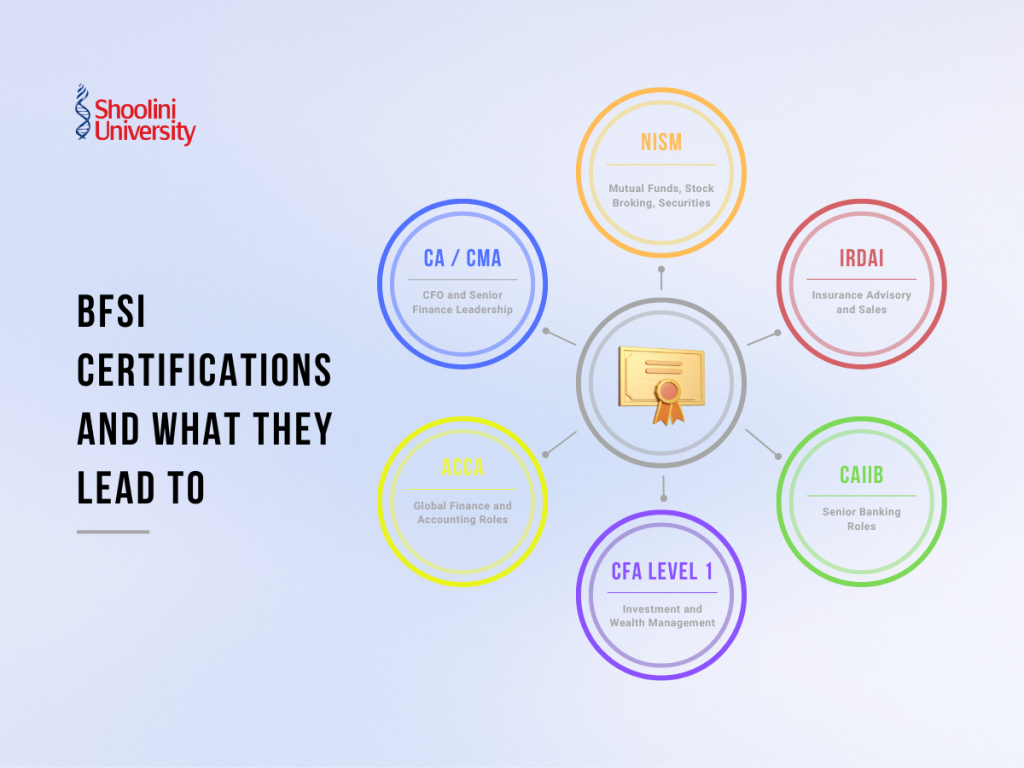
- CA / CFA / CMA
- MCom Banking & Finance
The BBA with BFSI specialisation is gaining strong traction as a career-first undergraduate degree — combining core business administration with sector-specific training in banking operations, financial products, insurance, and fintech from Year 1 itself.
Future of the BFSI Industry in India
The future of the BFSI industry in India is being shaped by AI, tighter regulation, financial inclusion, and global expansion — simultaneously.
India’s BFSI technology workforce is projected to reach 2.4 million by 2030, growing at a CAGR of 4.8% — significantly outpacing the broader financial services employment growth rate of 2.1% annually.
There is currently a 42% skill gap for AI and data roles in BFSI — and this deficit is expected to widen in 2026, meaning well-trained graduates will face far less competition for the best roles.
The scope of banking and insurance careers is expanding geographically as well. Tier-2 and Tier-3 cities like Indore, Coimbatore, Nagpur, Jaipur, and Lucknow are emerging as serious hubs for BFSI employment — not just metros.
AI is not replacing BFSI professionals. It is changing what they do. The sector needs people who understand both finance and technology, which is exactly what a well-structured undergraduate program in BFSI prepares you for.
How Shoolini University Prepares You for a Career in BFSI
If you are looking for a banking and finance course in Himachal Pradesh that goes beyond theory, Shoolini University’s BBA BFSI course is one of the most structured and career-ready options available in India today.
Here is what makes the program stand out:
Industry-Shaped Curriculum: The BFSI specialisation in BBA Shoolini is a 4-year program designed with input from professionals at McKinsey, PwC, and Citi, and faculty from IITs, IIMs, and ISB. The course stays current with what employers actually need — not outdated theory.
Hands-On Learning from Day One
- Real case studies drawn from the BFSI sector
- Regular sessions with industry leaders and practitioners
- Mandatory two-month paid summer internship with top companies
- Practical exposure to digital banking, financial products, and compliance tools
Strong Placement Record: Some of the recruiters include ICICI Bank, Deloitte, KPMG, Hindustan Unilever, Hewlett Packard, Hilti, and Mercer.
Skill Development Beyond Academics: Students build communication, leadership, and professional skills through:
- Stanford-Inspired SPRINT™ Bootcamp
- ATP (Advanced Training Program)
- V-Empower Coaching by ICF coaches
These are exactly the soft skills BFSI employers consistently prioritise in hiring.
Global Exposure: Students can participate in exchange programs and study tours with 250+ international collaborations with top global universities.
Recognised Credentials
- UGC-approved and NAAC-accredited with A+ grade
- Partnerships with NHRDN, KPMG, and LIBF
For Shoolini University BBA BFSI admission details, prospective students can reach out directly to the admissions office for the latest eligibility criteria and intake information.
Is a Career in BFSI Worth It in 2026?
Yes — and here is the clear case for it.
What is BFSI today is not what it was a decade ago. It is a technology-powered, data-driven, globally connected sector that touches every aspect of India’s economy. Roles are diverse, salaries are competitive, growth is structural — not seasonal — and the talent gap is real and widening.
Whether you want to work in a bank, a fintech startup, an insurance company, a wealth management firm, or a global financial institution, a well-chosen education in banking and finance puts you directly in line for roles India urgently needs to fill.
Start early, build the right skills, and choose a program that connects you to the industry from Day 1.
Sources:
- Business Standard — BFSI sector to add 250K jobs by 2030: https://www.business-standard.com/industry/news/bfsi-sector-to-add-250k-jobs-by-2030-focus-on-tier-ii-iii-cities-report-125082100508_1.html
- Taggd — BFSI Hiring Trends 2026: https://taggd.in/blogs/bfsi-hiring-trends/
- Jaro Education — Top Highest Paying Jobs in Finance India 2026: https://www.jaroeducation.com/blog/top-highest-paying-jobs-in-finance-sector-in-india
FAQs
Q1. Is mathematics compulsory for a career in the BFSI sector?
No — while basic numeracy and analytical skills are helpful, mathematics is not a strict requirement for most BFSI roles. Many positions in sales, relationship management, compliance, and insurance are open to students from any stream.
Q2. Can commerce students get jobs in fintech companies?
Yes — commerce students with knowledge of financial products, banking operations, and basic data tools like Excel and SQL are actively hired by fintech companies for roles in operations, product support, and customer success. Adding a course in digital finance or data analytics further strengthens your profile.
Q3. What certifications help students get placed faster in BFSI roles?
NISM certifications for mutual funds and securities, IRDAI certification for insurance, and CAIIB for banking are among the most recognised credentials in India. CFA Level 1 and ACCA certifications are also valued for investment and finance-focused roles.
Q4. Does Shoolini University offer internships in banks or financial companies?
Yes — a mandatory two-month paid summer internship with industry partners is built into Shoolini's BBA BFSI program. Past students have interned with companies including ICICI Bank, Deloitte, KPMG, and other leading BFSI organisations.
Q5. What entry-level salary can fresh graduates expect in the BFSI sector?
Fresh graduates entering BFSI typically earn between ₹2.5 and ₹4.8 LPA, depending on the role, employer, and location. Candidates with relevant certifications, internship experience, or a specialised BFSI degree tend to start at the higher end of this range.
Q6. Is BFSI a stable career during economic downturns?
Yes — BFSI is considered one of the most resilient sectors of the economy because banking, insurance, and financial services remain essential regardless of economic conditions. In fact, downturns often increase demand for roles in risk management, compliance, and credit recovery.
Q7. Can students switch from BFSI to MBA or finance specialisations later?
Absolutely. A BBA with BFSI specialisation is an excellent foundation for pursuing an MBA in Finance, a CFA, or a CA qualification. Many top business schools value candidates with prior domain experience in banking and financial services.


